

We often see businesses make the mistake of treating traditional SEO and optimising for AI as completely separate processes, even charging them as two different services.
While AI is changing how users interact with search, as a digital marketing agency at Elliptycs, we find that fundamental SEO best practices help optimise content for AI search like AI Overviews in Google and LLMs like ChatGPT or Claude.
We’re not alone in thinking this, Google backs this up by saying that the goal of any search tool is to help the user, so high-quality content that is trustworthy and helpful has a good chance of gaining visibility in AI search.
Read on to find out how our SEO services put this into practice for our clients, with examples to show how it works.
How Is Search Changing?
People often underestimate just how dominant Google still is. As of September 2026, Google holds 89.94% of the global search engine market share. For our clients based in the US, this number stays high at 85.19%, and in the UK Google’s dominance climbs to 91.39%. This is why Google is a strong reference point when we look at how search is changing in this article.
Two commonly-used terms that you may have seen are AEO (answer engine optimisation) and GEO (generative engine optimisation). While there is no consensus over definitions for these terms, they both describe improving a business’s visibility in AI-driven search experiences. That includes Google’s AI features, such as AI Overviews, as well as LLMs like ChatGPT and Claude.
AI search is still new and constantly evolving; we’ve already seen changes that have had an impact on the type of content that gets cited by LLMs. For example, a study by Seer Interactive analysed two million AI citations and found that listicle-style citations dropped by 30% between December 2025 and January 2026 alone. That’s the kind of shift that can alter optimisation advice, so we’ll keep this article updated as AI search continues to evolve.
How Is AI Used in Search?
AI Overviews, which are Google’s AI-generated summaries, now often appear at the very top of the search results page on Google, ahead of traditional results. According to SEMrush’s data, AI Overviews appear on 78% of results pages (UK, October 21, 2026) showing just how integrated they have become with search on Google.
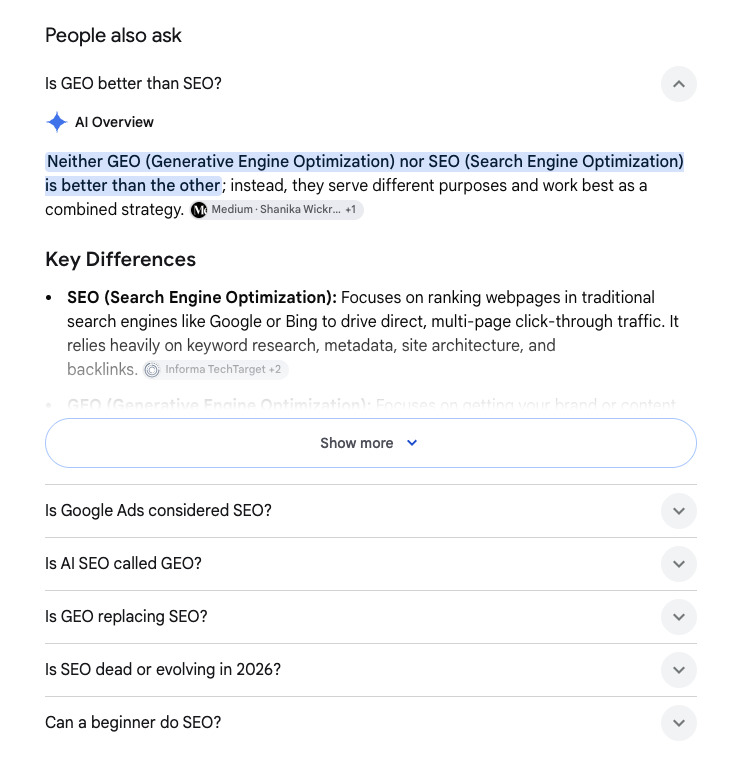
AI Overviews aren’t the only AI feature on the results page. Google also surfaces AI-generated content through People Also Ask, which displays a list of questions and short answers related to the original search query.
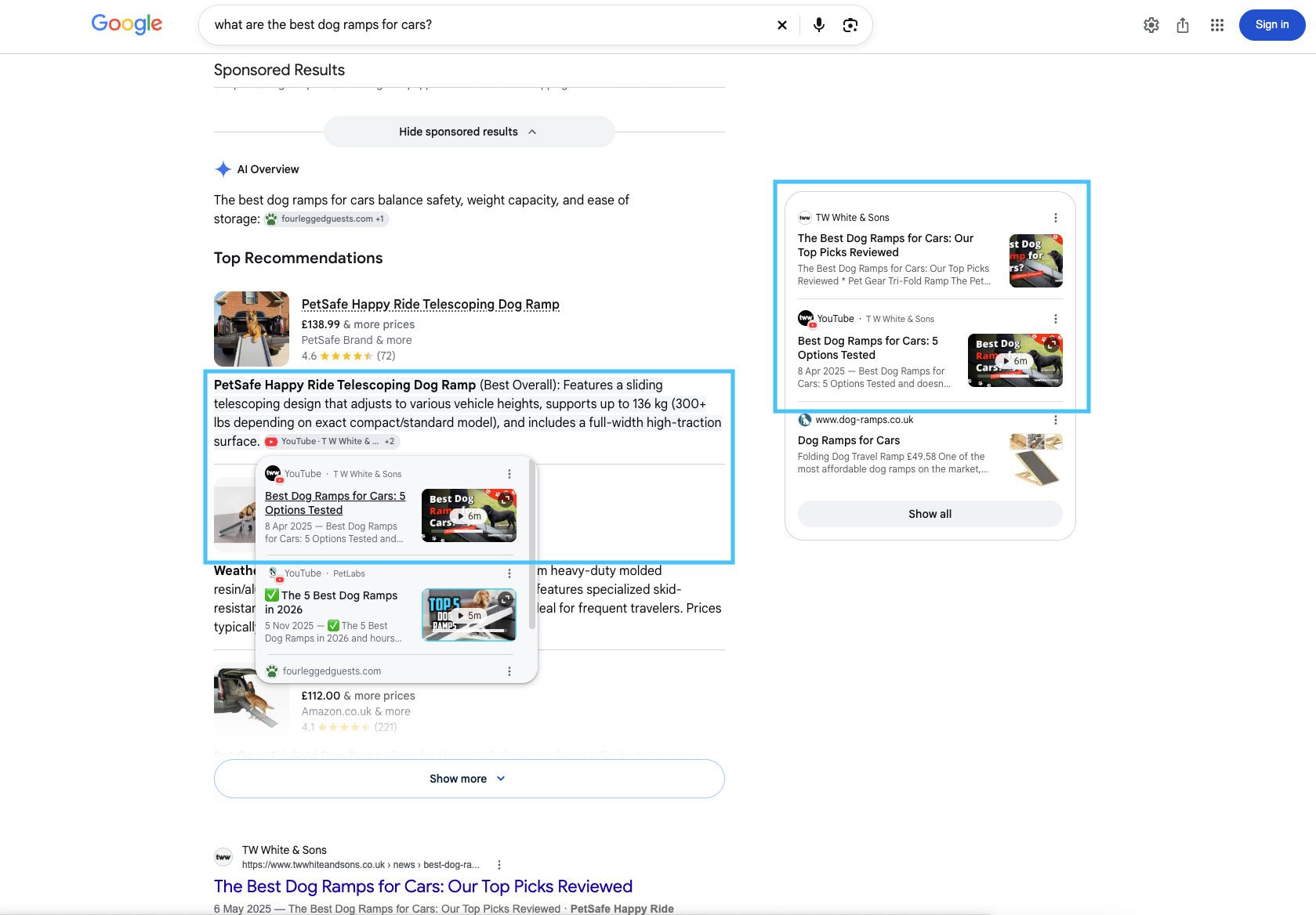
Google can also bring images and videos onto the results page. Below is an example of a video we created for our automotive client on the best dog ramps for cars, appearing on the results page. We repurposed the content into an article too, and in this instance, both the video and the article were being used to generate the product recommendations in the AI Overview.
In addition to Google, people are turning to LLMs (such as ChatGPT and Claude) to answer their questions and find services.
Depending on which model of LLM you’re using, the information it serves you may not be up to date. For example, all of Claude’s current models have a reliable knowledge cutoff of June 2026, so their information is limited after this cutoff without accessing the internet. With some LLMs there is the option to make them run a web search for their responses, such as Claude’s Research Mode.
OpenAI announced in February 2026 that ChatGPT had reached 900 million weekly active users, over doubling the reported 400 million weekly users in February 2025 by Reuters. This indicates that LLMs are becoming an increasingly popular search tool. The UK government also ran a study on AI use, and found that 73% of the public had used AI in their day-to-day life in the past month (February, 2024).
The Implications of AI in Search
For our clients, the largest negative effect of AI Overviews on a results page is a drop in click-through rate to the organic results beneath it.
A study by Ahrefs in April 2025 found that the presence of AI Overviews reduced the clickthrough rate to the top-ranking page by 35% on average. Ahrefs re-ran the study in February 2026 and found that this average had jumped to 58%. This highlights that AI Overviews are increasingly impacting results pages by absorbing clicks from organic results.
It’s also worth looking at the role LLMs play in driving traffic to your website. A study by Marie Haynes found that users arriving from ChatGPT to 100 different websites accounted for just 0.62% of the total volume. Although the usage of LLMs is certainly increasing, they don’t currently play a significant role in driving traffic to your website, not directly at least.
AI Overviews absorb more clicks and lower the clickthrough rate, which can reduce traffic to your website. We’ve seen this in our clients’ Google Search Console reports where there is an increasing number of impressions but a lower number of clicks. For many businesses, this weakens the incentive to create content.
One positive change with AI in search is that LLMs use information beyond the first page of Google to provide answers to search queries, so if you’re not currently ranking at the top you still stand a chance of getting cited.
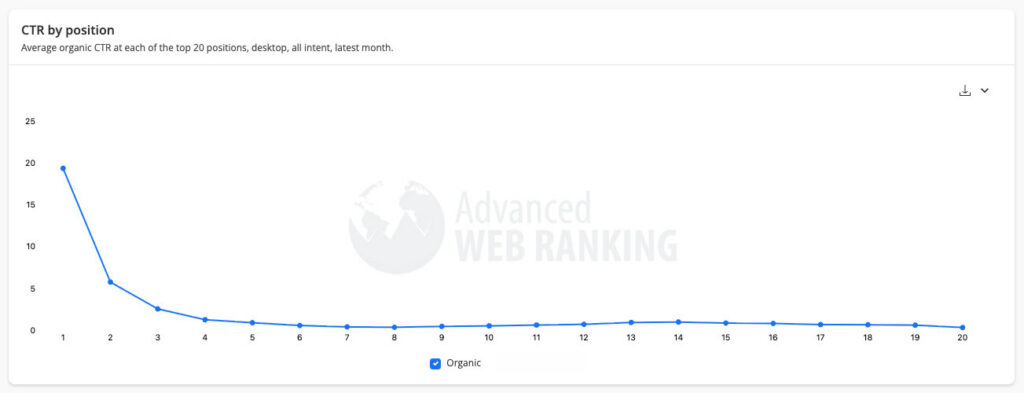
In a different Ahrefs study looking at 15,000 prompts, only 12% of AI-cited URLs rank in Google’s top 10 for the original prompt. Clicks on the first page of Google are concentrated to the first few organic results, as shown in Advanced Web Ranking’s graph below where the organic result’s position is the x-axis and the click-through rate is the y-axis. However, reading an answer in an LLM chat will likely contain information past the first few results, widening the scope of who is visible to searchers.
We’ve noticed at Elliptycs that AI search has also made it a lot harder to track content’s performance. A study by Kevin Indig found over a sample of 20,000 prompts that only 2% of URLs get cited by three different AI engines, ChatGPT, Perplexity and Google AI Overviews, for the exact same prompt. That inconsistency makes ranking-only performance tracking far less reliable than it used to be.
This is why we adapted our content decay review process to account for how our clients’ content is being used in AI Overviews and LLMs, not just how it ranks in traditional search.
How to Optimise Content in the AI Search Era
Although AI has certainly changed search, AEO isn’t just replacing SEO. In their AI optimisation guide Google maintains that fundamental SEO best practices are also what helps content perform well in generative AI search, as the end goal is all the same; to create content that is helpful to the user.
Here are the best practices we focus on as part of our SEO services at Elliptycs to get our clients’ content ranking on the results page and visible in AI Overviews and LLM chats.
Strong Title and Meta Description
One of the most important steps with any web page is to ensure it has a strong title and meta description, as this is what users will see on Google’s results page. This is the opportunity to persuade the user that your content is genuinely helpful.
We ensure that each piece of our clients’ content has a compelling title that matches search intent, whether the user is looking for information or a particular service. Titles should also be descriptive, concise and contain important keywords that are relevant to the topic. A strong title that stands out improves the chances of a user clicking on it.
A strong title is also important for AI visibility as AI search tools like ChatGPT run multiple variations of a user’s query behind the scenes to find relevant information, known as ‘fan-out’ queries. A study from AirOps found that pages with a title matching 50% or more of the original search query achieved a 20.1% citation rate in ChatGPT responses, more than double the 9.3% rate for pages with less than 10% overlap. This shows that when a title is written with the user in mind and covers the topic, it has a better chance of being picked up and cited in AI search.
The small excerpt of text below the title on the results page is called a meta description. While you can choose the meta description for each page, a study by SEMrush showed that Google only uses the chosen meta description 28% of the time and typically rewrites it automatically.
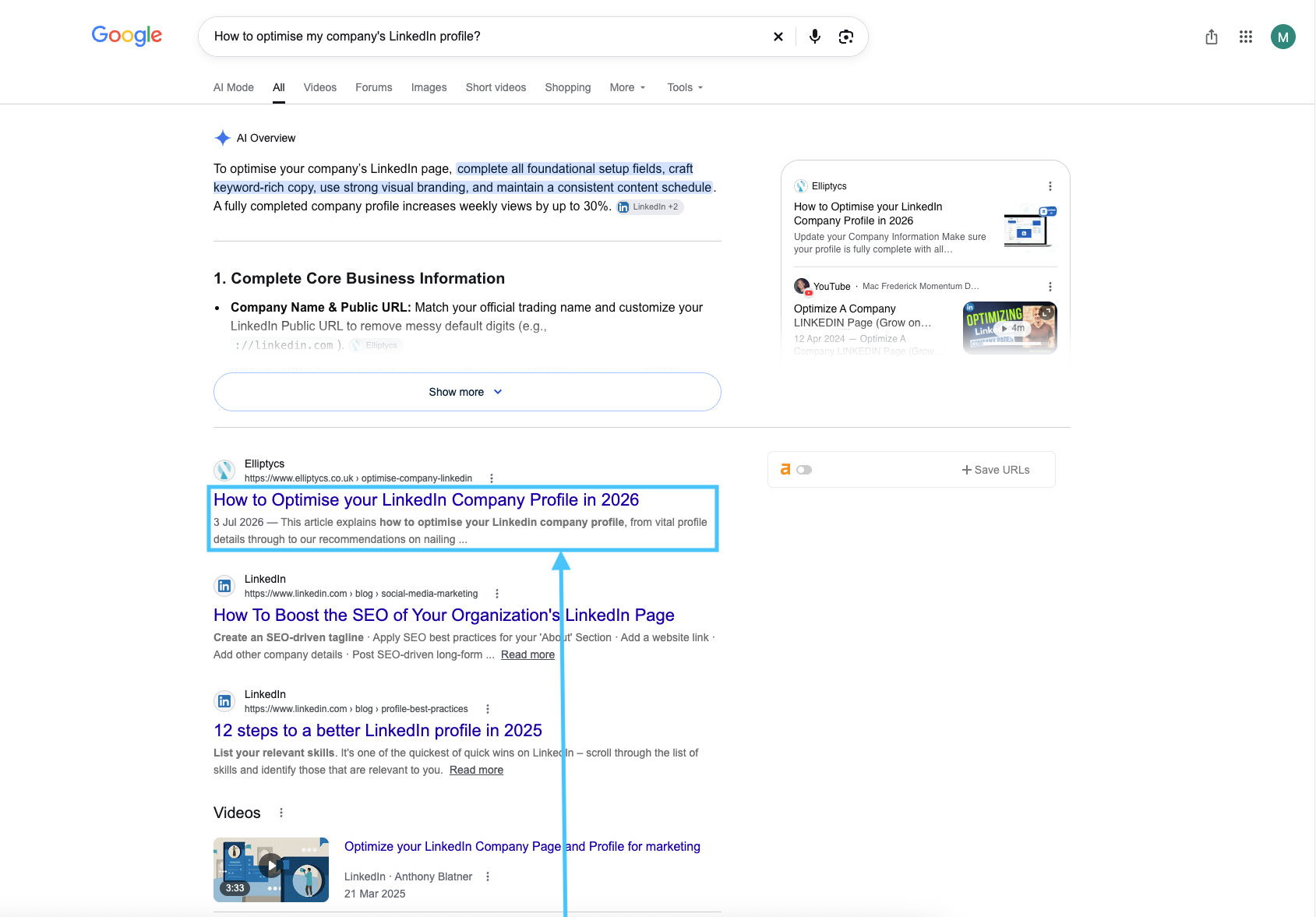
As part of our SEO audits, we constantly see businesses who don’t realise this, and are surprised that the meta descriptions for their key service pages or high-traffic blog articles weren’t what they expected.
Yoast ran a study and found that Google used sentences from the first paragraph in two-thirds of cases where it had rewritten the meta description.
This is why when we write content at Elliptycs, we write the introductory section with what we want to appear in the meta description in mind, and also put this into the meta description field to tell Google that it’s what we want to use as the meta description. We include relevant context to the user’s search query, clearly demonstrate the value that the user gains from the content, include important keywords to reinforce the relevance of the content, and a call to action for the user.
Strong Internal Linking
Internal linking is important as it shows how different pages on your website relate to each other. Contextually relevant links help users to find additional content or services that may be helpful. It can also help Google find and index new pages, which may allow them to appear on a results page quicker.
If you’re not sure on what parts of your websites are good linking opportunities, a quick way to find them easily is Google’s site search. Type ‘site:’ into the Google search bar followed by your domain’s name (without a space). Then add a space and type the content’s topic or keyword. This brings up pages exclusively on your website that relate to the topic or keyword.
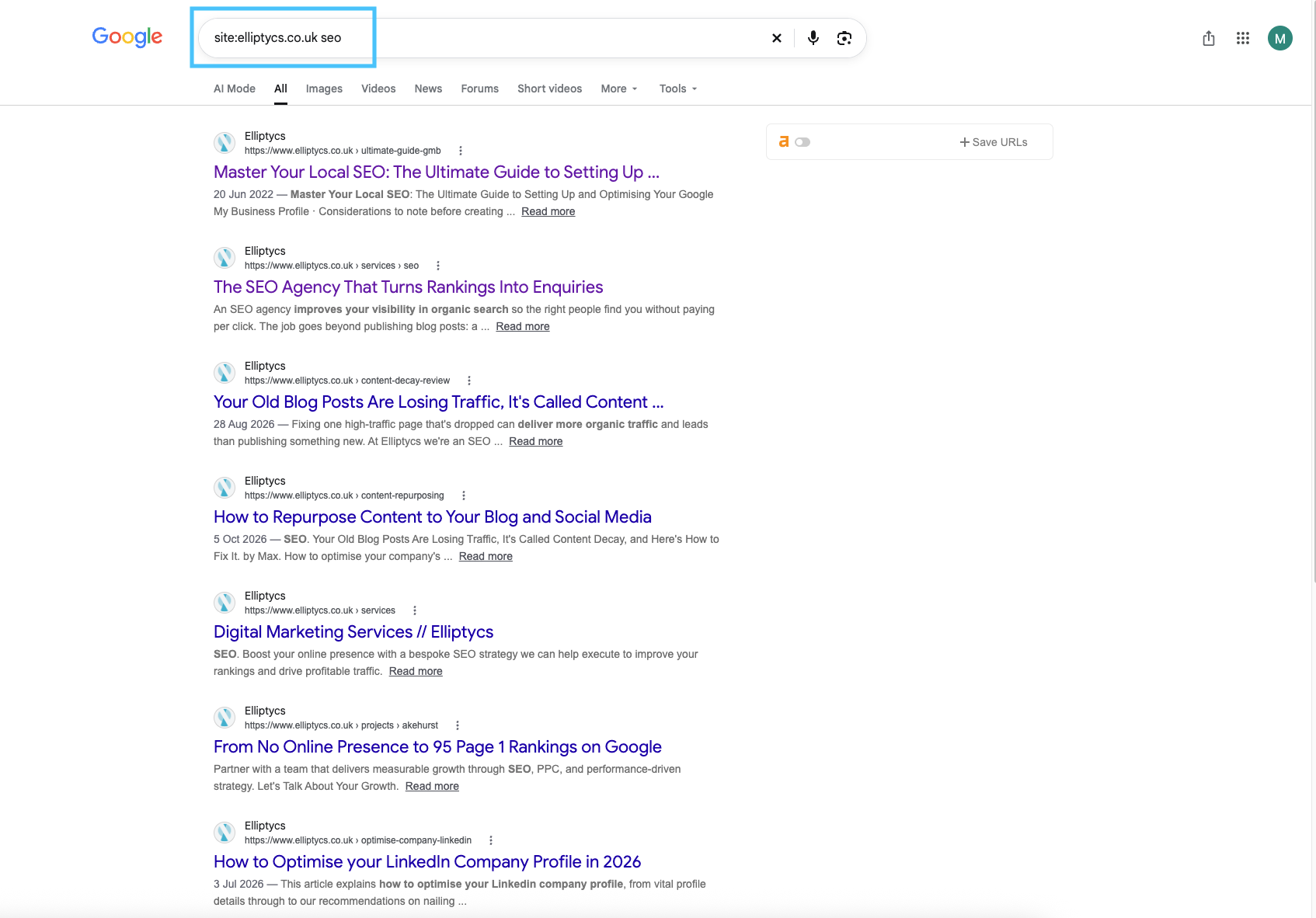
Below is an example of why building internal links can also be important for AI search.
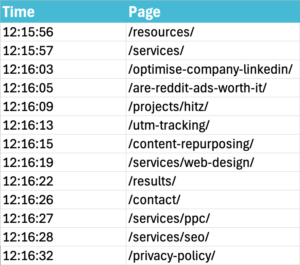
The table below shows a crawler visiting 19 pages on our website in 36 seconds. It didn’t request the sitemap during this particular window, which suggests link-following is a possible explanation for how it moved between the pages.
AI crawlers browse the web to find content, whether that’s to answer a query directly or to build the dataset a model is trained on. Strong internal linking makes it easier for these crawlers to move between the pages on your site once they land on it. If your content is easier to find then the chances your content gets used in AI search is better.
We also link to credible external resources to supplement our clients’ content and fill any information gaps. Relevant and credible external links enrich your users’ experience by providing easy access to more in-depth content on the topic.
We always recommend setting external links to ‘open in a new window’ so that the user can easily switch between the original piece of content and additional external resources.
Creating User-Focused Content
Ultimately, what we focus on at Elliptycs is creating unique, user-friendly, high-quality content, instead of just trying to optimise for an algorithm.
Google strongly supports this in their guide for optimising for AI search. In fact, Google suggest that creating unique, compelling and useful content will likely have the biggest influence for your website’s presence in generative AI search than other optimisation techniques.
Solve the user’s problem early
One important step we take to ensure our content is both user-friendly and AI-friendly, is to solve the user’s problem early in the content, whether that’s answering a question or explaining a service.
This keeps the user engaged and on your website longer. If you wait too long to give the user what they’re looking for, they may leave your site in search of an alternative result. This is also important for visibility in AI search for LLMs. A study by Kevin Indig found that 44.2% of ChatGPT citations came from the first third of the page’s content. This dropped to 31.1% for the middle third, and 24.7% for the final third. This demonstrates the intersection between creating user-friendly content and optimising for AI search.
Clear and Engaging Formatting
Using clear and engaging formatting is another way to make your content more digestible for users. At Elliptycs, we focus on breaking content up into scannable sections with headings, subheadings and bullet points. If a user arrives on a page and is greeted with a wall of text, it is harder for them to find what they’re looking for. This is tied in with the point above; creating content that solves the searcher’s problem quickly and clearly makes content user-friendly.
We also add our own high-quality images and videos to support our written content. Videos in particular can be used to expand on written content and build trustworthiness with the user.
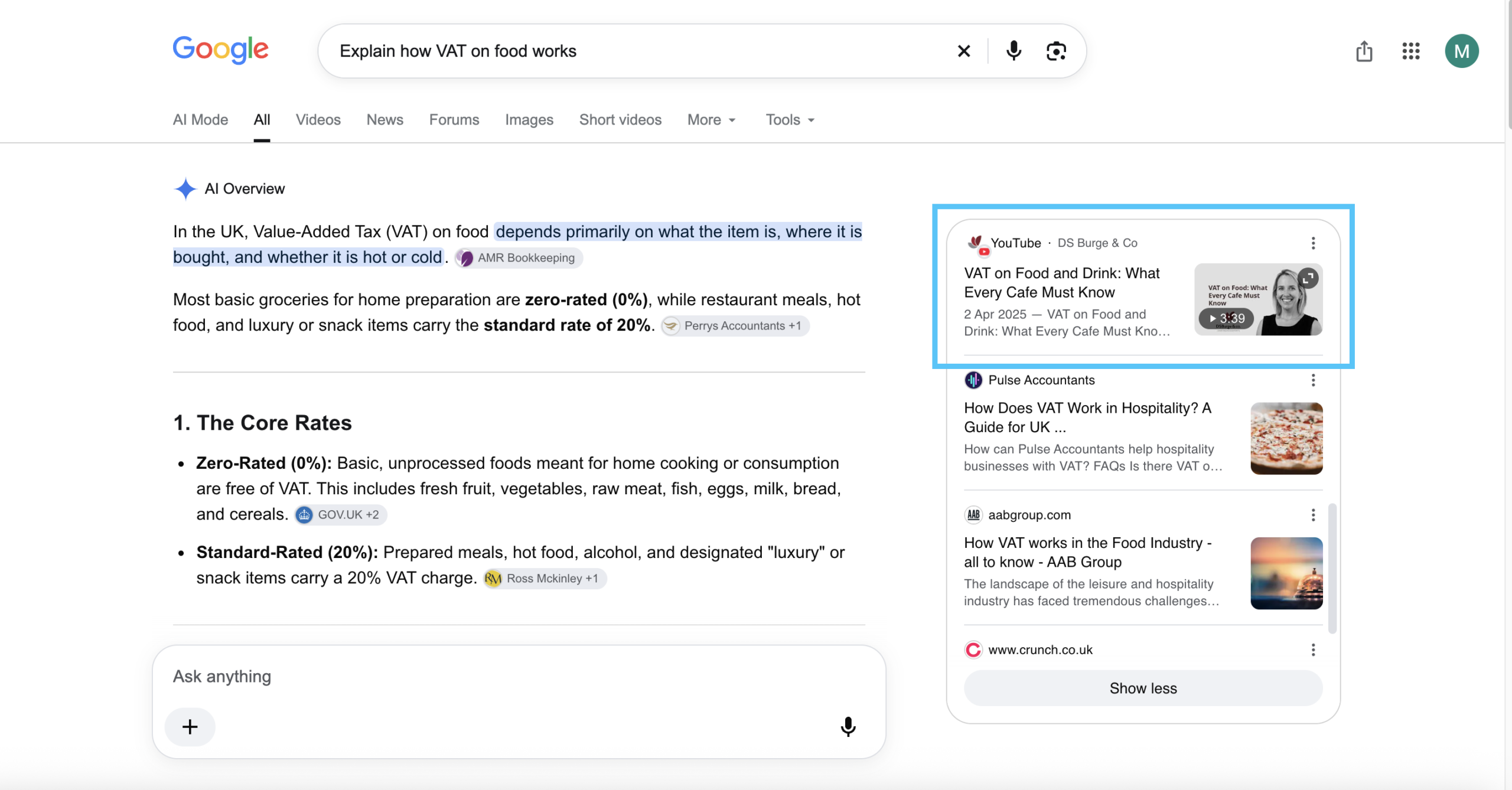
As we’ve already showcased, Google can pull in images and videos to its generative AI features so integrating them with written content can improve your visibility in AI search. Below is an example where our accountancy client’s article on VAT on Food and Drink wasn’t cited in an AI overview but the supplementary video was, demonstrating that it can be worth the time and effort to create videos to support written content.
Google’s E-E-A-T Framework
We also recommend that you follow Google’s E-E-A-T framework to create helpful content that users can trust. The acronym stands for: Experience, Expertise, Authoritativeness and Trust, and these are the qualities that Google looks for when deciding which content is worth ranking. Google stipulate that trust is the most important of these four qualities, and the other three contribute towards building trust. Below is how we develop these qualities across our clients’ sites:
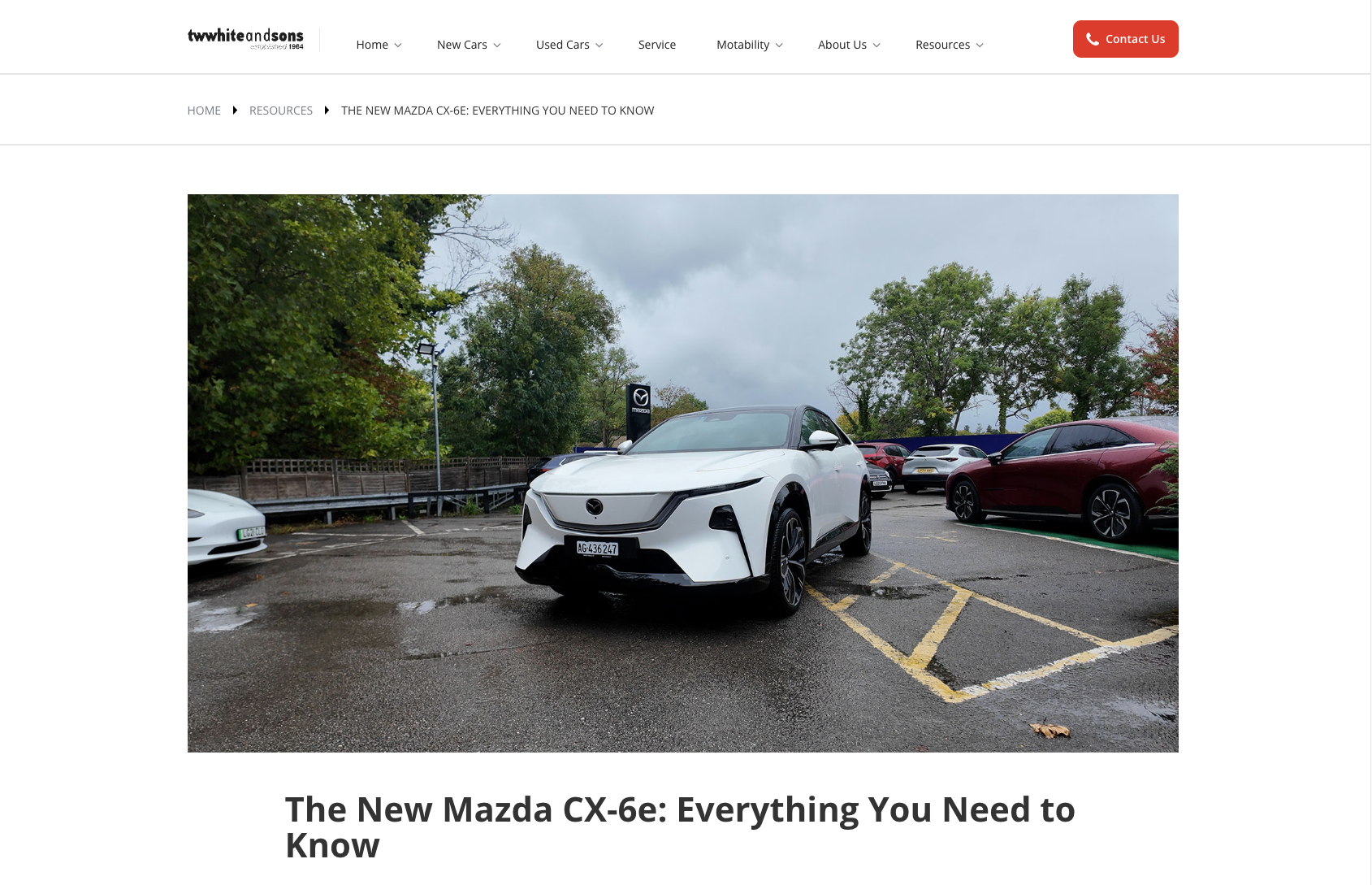
- Experience: We share authentic experiences such as first-hand experience with products, and use original images and videos. We recently did this for our automotive client when we reviewed the new Mazda CX-6e. We took our own videos and pictures of the car, which we used on the client’s website and social platforms to show users that the review was a first-hand experience.

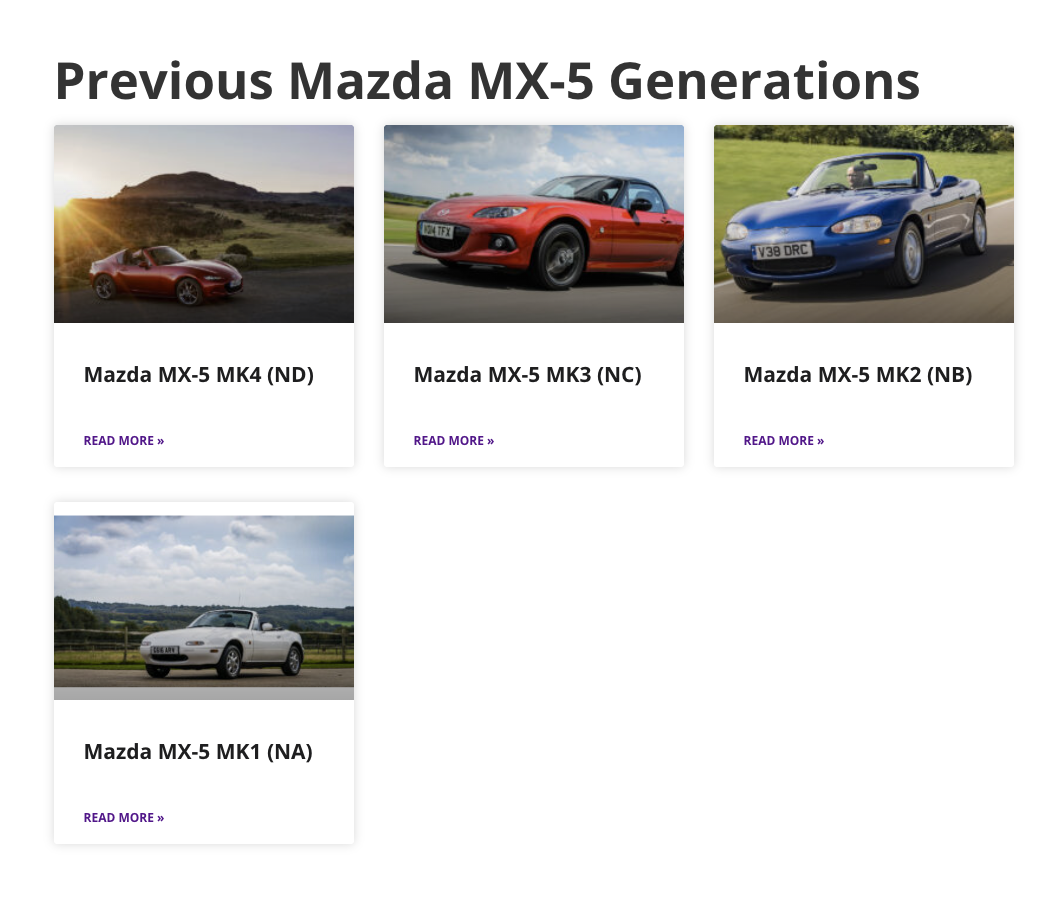
- Expertise: We create high-quality content for our clients by going beyond surface level research. When we created our Mazda MX-5 guide for our automotive client, we broke it down into sub-pages for every generation, researching the specs, features and driving styles for the MK1 through to the current MK4. We also think about how content connects across a site to reinforce expertise on a topic. We use our content calendar to map out a hub and spoke structure for our content, a main page on a topic (the hub) with related articles (the spokes) linking back to it and to each other, so every piece reinforces the ones around it rather than sitting in isolation.

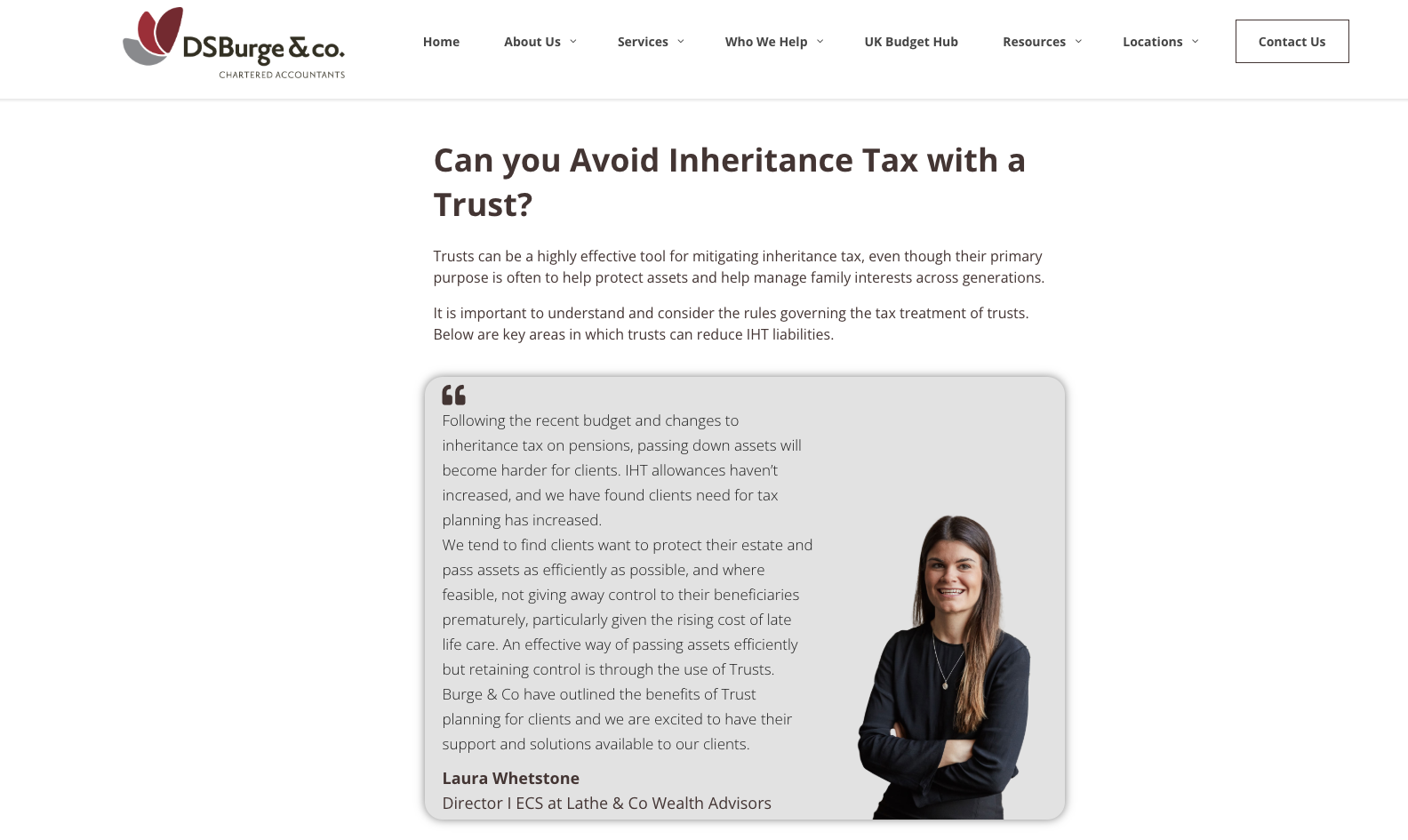
- Authoritativeness: At Elliptycs, we use platforms such as Qwoted to connect with industry experts who can provide supporting insights for our content. An example of this can be seen below where we got a quote from a wealth advisory firm to support our article on inheritance tax.
- Trust: We build an ‘About Us’ page for all our clients to show who the people behind the business are, and provide contact information and testimonials to show customer satisfaction. We fact-check content, and run a content decay review every quarter to ensure it’s up to date.
E-E-A-T isn’t just important for building trust with users, it also matters for Google’s generative AI features. A study by Ahrefs found that 76% of AI Overview citations came from top 10 search results. This suggests that these AI answers have strong E-E-A-T signals.
It’s also important we consider the effect E-E-A-T has on LLMs, which Ahrefs covered in their study too. E-E-A-T is a Google-specific framework and LLMs don’t “use” it like Google do. LLMs sometimes search the web in real time to find an answer to a user’s query. If they search via Google, then these results likely adhere to Google’s E-E-A-T standards.
Conclusion
Search is definitely changing, but for AEO or GEO and SEO, they all share the same goal: creating high-quality content that is user-friendly, trustworthy and unique.
Our automotive client’s dog ramp video and article appearing in an AI Overview didn’t need a separate AI strategy, it came from researching the questions that customers were already asking and creating content that answered them in a clear, helpful fashion, demonstrating first-hand experience with the products.
The SEO fundamentals that we use for our clients, a strong title and meta description, solid internal linking, and content built around the user’s problems, also help optimise content for AI search. As supported by Google, the end goal is creating content that’s genuinely helpful to the user.
Take a look at how our SEO services can keep your content ranking on the results page and visible in AI search as it continues to evolve.


